
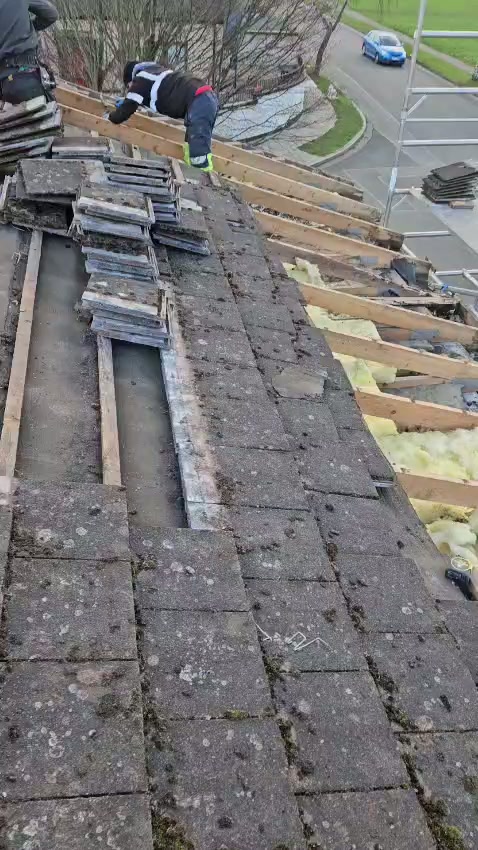
Victorian and Edwardian slate roofs
Common across Rathmines, Rathgar, Ranelagh, Sandymount and Monkstown. The slate itself is often still excellent; the nails are not. Slates slip in ones and twos, and each one lets water at the battens. Add large chimney stacks with old lead and hidden parapet or box gutters, and you have the three most common leak sources in period Dublin housing in one roof.
Red-brick terraces
The concealed gutter behind the parapet is the thing to watch. Leaves and moss block it, water backs up above the slate line and comes straight through an upstairs ceiling. Clearing it twice a year prevents most of it.
Coastal homes
Howth, Sutton, Malahide, Portmarnock, Dalkey and Killiney. Salt-laden wind erodes ridge and hip mortar, corrodes fixings and lifts flashings. These roofs need checking more often than inland ones — that is not sales talk, it is just exposure.
1970s to 1990s estate housing
Castleknock, Dundrum, Leopardstown, Raheny and similar. Concrete tile that still looks fine from the road, over sarking felt that has gone brittle and torn at the eaves. The first symptom is usually damp or mould in the attic rather than a drip in a bedroom.
Rear extensions and dormers
Almost universal in Dublin and almost universally the source of a flat roof problem eventually. Ponding water because there is no real fall, and failed upstands where the flat roof meets the original house wall.
Related pages: roofers in Dublin, roof repairs in Dublin or flat roofing in Dublin.